Profit vs Cash Flow: Why Profit Isn't Money in the Bank
A business owner looks at a profit and loss statement showing a healthy profit for the quarter, then opens the banking app and finds the account overdrawn. It feels like the accounts must be wrong. Usually they are not. Profit and cash measure two different things, and a business can have plenty of one and almost none of the other.
Understanding the gap between them is one of the most useful financial skills an owner can have. It explains why growing businesses so often hit a cash crunch, and it shows you exactly where to look when the bank balance does not match the story your profit figure is telling.
Profit and cash flow are answering different questions
Profit answers the question: did we earn more than it cost us to earn it? It is calculated by matching income to the period in which it was earned and expenses to the period in which they were used up, whether or not any money has changed hands. That is the accrual basis of accounting, and it is how most businesses produce their profit and loss statement.
Cash flow answers a simpler question: how much money came in, how much went out, and what is left? It follows the actual movement of money in and out of your bank, mobile money and cash accounts.
Both are true. They just measure different things, at different times.
Five reasons profit and cash move apart
1. Customers pay later than you record the sale. When you invoice a customer on 30-day or 60-day terms, the sale counts as income straight away, but the cash arrives weeks later. Until it does, your profit is sitting in accounts receivable.
2. Stock is paid for before it is sold. Buying inventory uses cash immediately, but it only becomes an expense (cost of goods sold) when the goods are sold. A shop stocking up for a busy season can spend heavily without any effect on profit that month.
3. Equipment is expensed over years, but paid for today. A $6,000 machine reduces cash by $6,000 on the day you buy it. On the profit and loss statement it appears only as depreciation spread over its useful life, perhaps $100 a month.
4. Loan repayments are not expenses. The interest on a loan reduces profit. The principal repayment does not, because it reduces a liability rather than creating a cost. Yet both leave your bank account.
5. Owner drawings and taxes come from cash, not profit. Money the owner takes out of the business, and tax payments on last year's profit, reduce cash without appearing as normal operating expenses for the period.
A worked example
Here is a hypothetical example. Lumen Home Supplies, a small homewares retailer, prepares for its busiest season. These are its figures for the quarter from July to September.
On the profit and loss statement:
| | Amount | |---|---| | Sales (mostly to trade customers on 60-day terms) | $60,000 | | Cost of goods sold | −$36,000 | | Operating expenses | −$15,000 | | Depreciation on new equipment | −$500 | | Net profit for the quarter | $8,500 |
A solid result. Now look at what actually happened to the money.
In the bank account:
| | Amount | |---|---| | Opening cash, 1 July | $20,000 | | Cash collected from customers | +$38,000 | | Paid to suppliers (including extra stock for the season) | −$41,000 | | Operating expenses paid | −$14,000 | | Loan principal repaid | −$3,000 | | New display equipment bought | −$6,000 | | Closing cash, 30 September | −$6,000 |
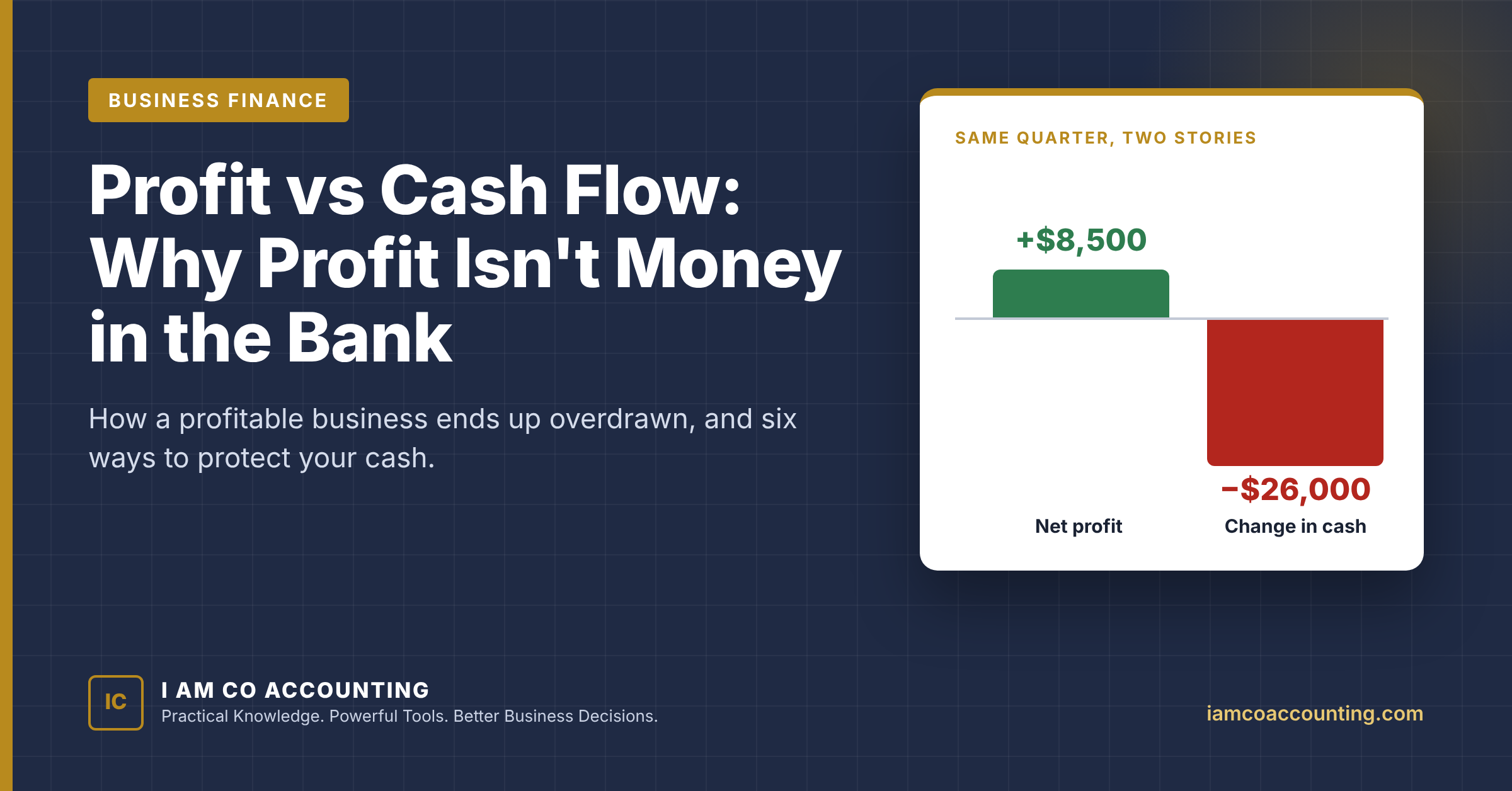
The business made $8,500 of profit and its cash fell by $26,000, leaving it $6,000 overdrawn. Nothing was hidden. $22,000 of sales had not yet been collected, a large stock purchase was paid for before the goods were sold, and the equipment and loan payments left the bank without touching profit in the same way.
If the owner only watched the profit figure, the overdraft would have come as a shock. If the owner had a simple cash flow forecast, they would have seen it coming in June and arranged an overdraft facility, negotiated supplier terms or staggered the stock purchase.
Six practical ways to protect cash flow
Forecast cash, not just profit. A rolling 13-week cash flow forecast, listing expected receipts and payments week by week, shows you a shortfall before it happens. Even a basic spreadsheet is far better than nothing.
Invoice immediately and chase on time. Send invoices the day work is completed, state clear payment terms, and follow up the day after a due date. An aged receivables report reviewed every week keeps this visible.
Match payment terms. If customers pay you in 60 days, try to agree similar terms with major suppliers. Paying in 14 days while waiting 60 to be paid is a structural cash drain.
Buy stock against a plan. Review slow-moving items regularly and avoid tying up cash in stock you will not sell soon.
Separate tax money. Move a percentage of each receipt into a separate account for sales tax, VAT and income tax so that tax bills never compete with payroll.
Read the cash flow statement every month. Your accounting software can produce a statement of cash flows alongside the profit and loss. Reviewing both during your month-end close tells you whether profit is turning into cash.
Build the financial habits that keep cash visible
The Practical Accountant explains profit, cash, the balance sheet and month-end routines in plain English, using a running case study of a small business so you can see how each transaction affects the reports. It is a practical starting point for owners and new bookkeepers who want to read their numbers with confidence. Get it for $19.99 or browse the I AM CO ACCOUNTING store.
If your business is profitable but always short of cash, it is usually a systems problem rather than a sales problem. Our team of professional accountants and Certified QuickBooks ProAdvisors builds cash flow forecasts, management reporting and bookkeeping systems for businesses in many countries. Book a free Financial Systems Health Check and we will help you find where your cash is getting stuck.
Frequently asked questions
What is the difference between profit and cash flow? Profit is income minus expenses for a period, recorded when income is earned and costs are incurred. Cash flow is the actual money moving into and out of the business. Timing differences, stock purchases, equipment, loan repayments and owner drawings cause the two to differ.
Can a profitable business go bankrupt? Yes. A business fails when it cannot pay its debts as they fall due, and that depends on cash rather than profit. Profitable businesses that grow quickly or give customers long payment terms are especially exposed.
Which matters more, profit or cash flow? Both matter. Profit shows whether the business model works over time. Cash flow shows whether the business can survive the next few weeks and months. Owners need to watch both.
How do I improve cash flow without increasing sales? Collect receivables faster, negotiate longer supplier terms, reduce excess inventory, spread large purchases, set aside tax money and use a cash flow forecast to plan ahead.
What is a cash flow forecast? A cash flow forecast is a projection of the money you expect to receive and pay over the coming weeks or months. It shows the expected bank balance for each period so that you can act early when a shortfall appears.
This article provides general financial information and is not investment, tax or legal advice. For further reading, see The difference between profit and cash flow by AccountingTools.
Written by the I AM CO ACCOUNTING team of professional accountants and Certified QuickBooks ProAdvisors. I AM CO ACCOUNTING is a business division of I AM CO GM (SL) LIMITED.
Need help applying this to your business?
Our accountants and QuickBooks ProAdvisors work with businesses and NGOs in Sierra Leone and worldwide.
Request a free consultationKeep reading
Segregation of Duties for Small Business: A Practical Guide
Segregation of duties for a small business, made practical: which tasks to split, compensating controls for tiny teams, and QuickBooks Online settings.
QuickBooksHow to Reconcile a Bank Account in QuickBooks Online
Step-by-step guide to reconciling a bank account in QuickBooks Online, with a worked example and fixes for when the difference will not reach zero.